How the COE Quota Is Set in Singapore
Before each twice-monthly exercise, LTA sets the COE quota for the next three months. Under the zero vehicle-growth policy it mostly equals the COEs freed by cars deregistered in a recent 12-month window, averaged over four quarters, with adjustments.
On this page11 sections · tap to jump
- 01The quota, in one sentence
- 02Who sets the quota and when
- 03The zero-growth starting point
- 04What goes into the quota
- 05Smoothing: the four-quarter average
- 06Why supply swings: the 10-year echo
- 07Cut-and-fill: borrowing from the peak years
- 08A recent quarter, by the numbers
- 09Can’t they just add more COEs?
- 10Where to check the numbers yourself
- 11Frequently asked questions
Everyone watches the COE price, but the price is really an auction outcome — what decides it is the supply: how many COEs LTA releases each quarter. That number is not set by a mood or a forecast. It follows a defined recipe built around one rule: the car population is not allowed to grow. This page explains how that quota is calculated, why it swings so much from year to year, and what LTA does to smooth it. For what a COE is and how bidding works, see what a COE is and how it works.
The quota, in one sentence
The Vehicle Quota System (VQS) “caps the number of new vehicles that can be registered in Singapore… given the limited road space,” in LTA’s words. Every three months LTA publishes a quota — the number of COEs available in each of the five categories (A, B, C, D and E) — and that quota is what bidders compete for. Because the total is capped, the quota is overwhelmingly made up of COEs that have just been returned to the pool by vehicles leaving the road.
Who sets the quota and when
LTA sets and announces the quota every three months, and “before the start of each bidding exercise, the bidding period and the number of COEs available for each category… will be announced.” The announcement for the next quarter is made the month before it starts. So the headline you see — “COE quota for August to October 2026” — is a quarterly allocation, spread across that quarter’s bidding exercises, held twice a month.
The zero-growth starting point
The whole calculation rests on the vehicle growth rate. Since February 2018 it has been set at 0% per annum for Categories A, B and D (private cars and motorcycles), while Category C — goods vehicles and buses — keeps a 0.25% per annum growth rate. LTA has confirmed this will stay in place until 31 January 2028.
Zero growth is a deliberate land-use choice, not an accident of the formula. As the Transport Ministry put it, Singapore has “about one million vehicles on our roads, including more than 650,000 cars,” and “roads currently take up about 12% of our total land.” Letting the fleet grow would mean building more roads or accepting worse congestion — so the number of cars is held flat and COEs are recycled rather than added.
What goes into the quota
LTA spells out the ingredients each quarter. The August to October 2026 quota, for example, was built from:
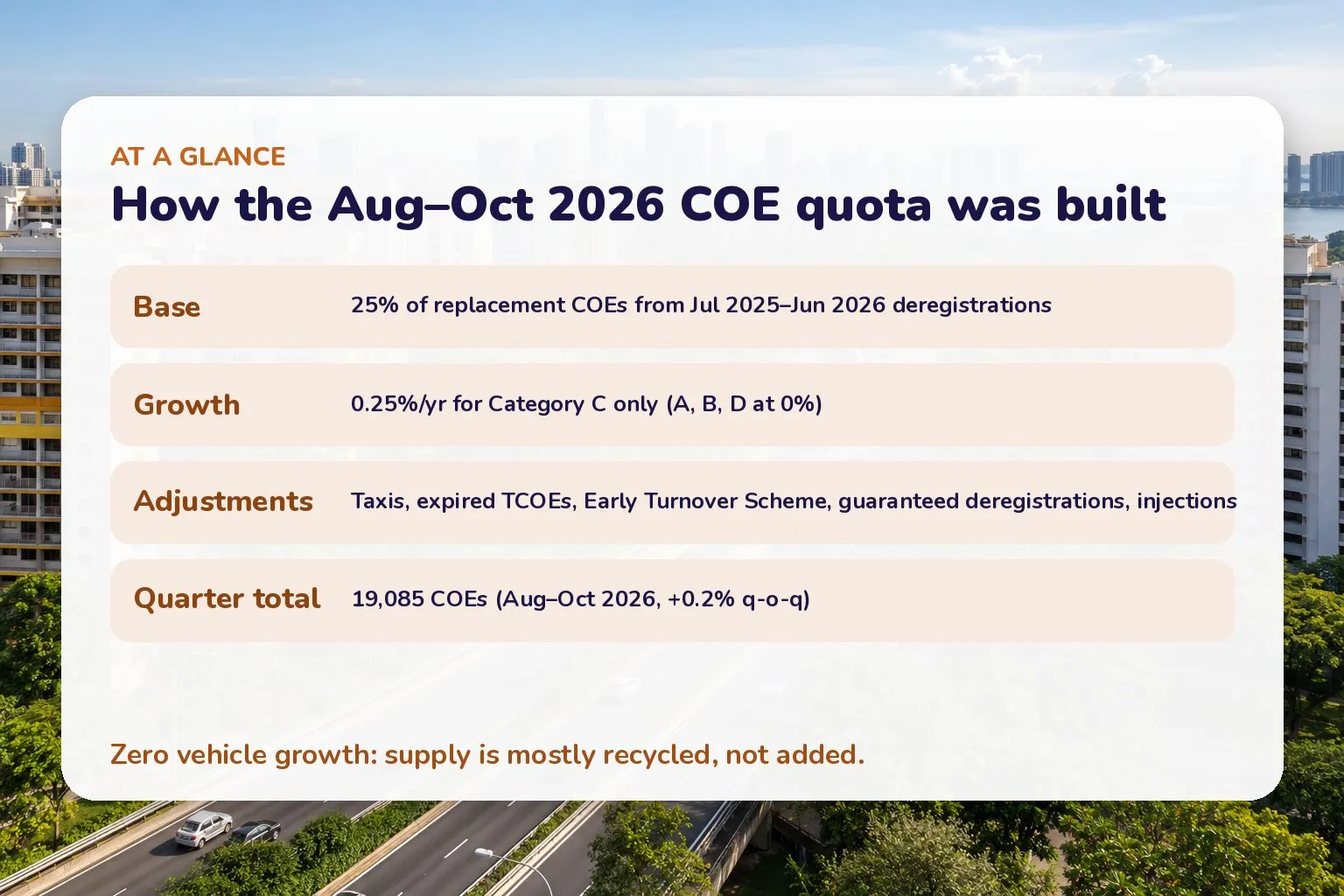
How LTA built the Aug–Oct 2026 COE quota. Source: LTA, Jul 2026.
- 25% of the replacement COEs from vehicles deregistered in the twelve months from July 2025 to June 2026 (a quarter is one-quarter of a 12-month window, hence 25%);
- a provision for 0.25% per-annum growth for Category C, based on the Category C vehicle population as at 31 December 2025; and
- adjustments for changes in the taxi population, expired Temporary COEs, the Early Turnover Scheme for commercial vehicles, redistribution from identified guaranteed deregistrations, and injections of additional COEs.
So the bulk is replacement supply, Category C gets a sliver of real growth, and a set of adjustments trims or tops up the rest. There is no discretion to simply “print” more COEs for cars.
Smoothing: the four-quarter average
If the quota simply mirrored last quarter’s deregistrations, it would lurch up and down. To damp that, from February 2023 the number of COEs available each quarter is the rolling average of deregistrations in the previous four quarters, rather than a single preceding quarter. MOT confirmed the switch: “instead of just the preceding quarter, we now use the moving average of de-registrations in the four preceding quarters to compute COE quotas for the next quarter.” Averaging over a year of deregistrations keeps the quota from spiking or collapsing on a single noisy quarter.
Why supply swings: the 10-year echo
Here is the uncomfortable truth the formula bakes in: today’s supply is an echo of car-buying a decade ago. A COE lasts 10 years, so the cars being deregistered now are the cars registered around ten years earlier. When a lot of cars were registered in a given year, a lot of COEs come back ten years later (a supply peak); when few were, supply falls into a trough.
MOT described exactly this: Categories A, B and C faced “a tight supply situation because many of the existing vehicles have not reached the end of their COE period,” with supply projected to “increase significantly from second half of 2024 before reaching the peak supply years from 2026 to 2027.” And “a large difference in the supply during the peak and trough years results in higher volatility in COE prices across different years, assuming demand stays relatively constant.” In short, the quota is doing its job as an allocation mechanism — the volatility comes from the uneven history of registrations, not from LTA changing its mind.
Cut-and-fill: borrowing from the peak years
To take the edge off those swings, LTA uses what the Minister called a “cut-and-fill” approach: “shave off the future peaks and use this supply to fill the current troughs.” The idea is to move some supply out of an upcoming peak year into a lean year, flattening the peak-to-trough ratio.
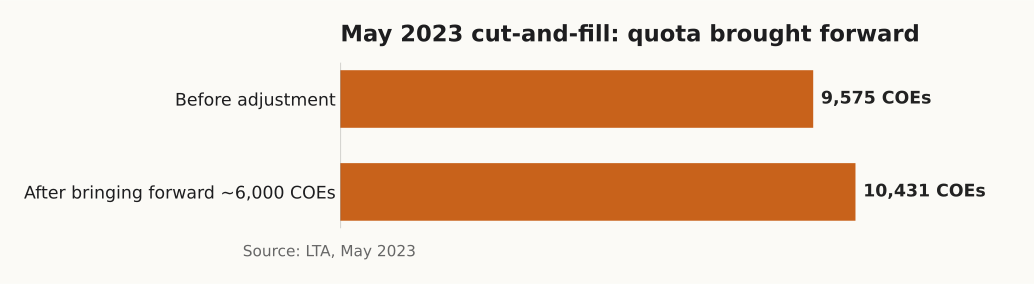
The May 2023 one-time ‘cut-and-fill’ lifted the quarter’s quota from 9,575 to 10,431. Source: LTA, May 2023.
The clearest example was the May 2023 one-time adjustment. LTA brought forward the guaranteed deregistrations of 5-year non-extendable COEs due to expire in a projected supply peak and redistributed about 6,000 of them gradually over several quarters. That raised the May–July 2023 quota from 9,575 to 10,431, a 24% increase for Category A and 15% for Category B across the remaining exercises of that quarter. Later, for November 2023 to January 2024, LTA increased the Category A and Category B quota by 35% each versus the previous quarter.
A recent quarter, by the numbers
For a concrete figure: the COE quota for August to October 2026 was 19,085 across all categories, which LTA noted was 0.2% more than the previous quarter (May to July 2026). That total is then split across the five categories and spread over the quarter’s bidding exercises. The premiums those COEs eventually fetch are a separate, market-driven outcome:
| Category | Quota premium | Quota | Bids received |
|---|---|---|---|
| Cat A · cars ≤1600cc & ≤97kW | $132,004 | 1,191 | 1,574 |
| Cat B · cars >1600cc or >97kW | $131,901 | 923 | 1,149 |
| Cat C · goods vehicles & buses | $92,200 | 308 | 481 |
| Cat D · motorcycles | $10,778 | 539 | 611 |
| Cat E · open | $135,790 | 270 | 411 |
Historical official results, updated after each exercise — not a forecast. See all COE data →
Latest premiums by category, direct from the official LTA dataset. The quota sets how many COEs are offered; bidders set the price.
Can’t they just add more COEs?
This is the most common question, and the answer runs through everything above. Under zero growth, “the number of COEs available for bidding is based on the number of deregistered vehicles” — LTA can re-time supply with cut-and-fill, but not permanently inflate it without abandoning the car-population cap. And even when supply rises, prices may not fall, because demand is outside the Government’s hands:
Where to check the numbers yourself
Every quarter’s quota is published in LTA’s quota announcement and its Annex, and the historical series of quota, Quota Premium and Prevailing Quota Premium is available in the official data.gov.sg motor-vehicle dataset. If you want to anticipate supply, watch two things: the quarterly quota announcement (made the month before each quarter) and the registration peaks of roughly ten years earlier, which signal when deregistration — and therefore supply — should rise.
Frequently asked questions
Does the quota differ by category? Yes. Each of Categories A, B, C, D and E has its own quota, computed from that category’s own deregistrations. Only Category C carries a real growth allowance (0.25% a year); A, B and D are held at zero growth.
Is the quota announced before every exercise? The allocation is set quarterly, but the specific number of COEs for each category is confirmed and published before each bidding exercise within that quarter.
Why did supply rise so much in 2023–2024? Because the cars registered around 2013–2014 reached their 10-year mark and were deregistered, returning their COEs to the pool — amplified by cut-and-fill bringing some future supply forward.
Does renewing a COE affect the quota? Renewing keeps a car on the road without a fresh COE being issued, so it does not add to the biddable quota. Renewal is priced at the Prevailing Quota Premium — the moving average of COE prices over the last three months.
Related
- What a COE is and how it works
- COE categories A, B, C, D and E explained
- How to bid for a COE
- COE renewal and PQP explained
General information on how the vehicle quota is calculated, not financial or buying advice. Figures are from LTA and MOT as of the dates stated; confirm the current quarter’s quota on the LTA website before relying on it.
Sources
- Certificate of Entitlement (COE) and the Vehicle Quota System — Land Transport Authority (OneMotoring) (as of October 2026)
- COE Quota for August 2026 to October 2026 (quota components) — Land Transport Authority (as of October 2026)
- One-time Adjustment to Reduce Volatility for COE Categories A and B — Land Transport Authority (as of October 2026)
- Oral Reply on COE Demand and Supply (zero-growth, four-quarter average, cut-and-fill) — Ministry of Transport (as of October 2026)
- Motor Vehicle Quota, Quota Premium and Prevailing Quota Premium, Monthly — SingStat / Land Transport Authority (data.gov.sg) (as of October 2026)