Petrol vs Electric Car: Real Cost
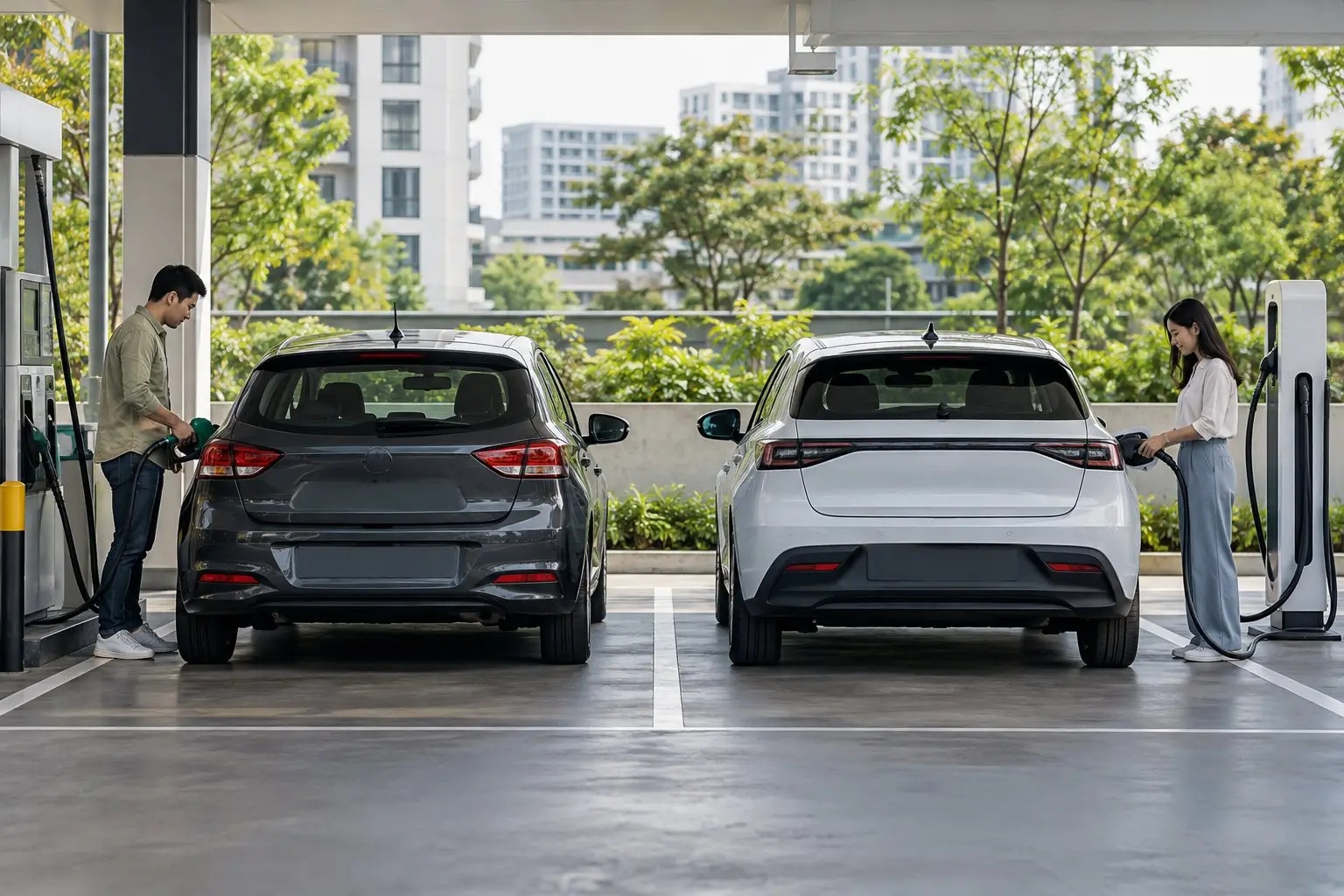
An electric car usually costs less to 'fuel' but can carry higher road tax. Home charging at the Q4 2026 rate (31.16 cents/kWh with GST) runs about S$5 per 100km, but EVs pay road tax by power rating plus a S$700-a-year flat component, and get VES/EEAI rebates upfront — but the EEAI ends 31 Dec 2026.
“Is an EV cheaper to run?” The honest answer in Singapore is: cheaper to fuel, but not automatically cheaper overall. Electricity costs less than petrol per kilometre, yet EV road tax can be higher, and the generous upfront rebates are tapering. Here is how the pieces compare, with the official figures.
Fuelling cost: electricity vs petrol
Charging at home uses the household electricity tariff, which SP Group sets each quarter. For 1 October to 31 December 2026 it is 28.59 cents/kWh before GST (31.16 cents with GST).
A typical EV using around 16 kWh per 100km (illustrative) therefore costs roughly S$5 per 100km in electricity at home. Public fast charging costs more and varies by operator, so check current rates where you charge — it narrows the gap with petrol.
Petrol pump prices change frequently and are set by retailers, so we don’t quote a fixed figure here — check the day’s pump price. Part of every litre is fuel excise duty, which petrol cars pay at the pump.
Road tax: where EVs can cost more
EVs don’t pay fuel duty, so Singapore collects a usage tax through road tax instead:

EVs pay a flat component instead of fuel duty.
- Petrol car: road tax is based on engine capacity — about S$743 a year for a 1,600cc car.
- Electric car: road tax is based on the motor’s power rating, plus an Additional Flat Component (AFC) of S$350 per 6 months — S$700 a year. For a powerful EV, the power-rating portion alone can exceed a small petrol car’s road tax, so total EV road tax is often higher.
LTA introduced the AFC in 2020 because EVs pay no fuel excise duty: it is meant to enhance parity with petrol cars until a distance-based tax is ready.
Upfront: rebates favour EVs — for now
Electric cars get an ARF rebate under the Revised VES (up to S$22,500 for the cleanest cars in 2026) and a further EEAI rebate of 45% of ARF (capped at S$7,500 in 2026). But the EEAI ends on 31 December 2026 — from 2027 only VES rebates apply. See EV rebates: VES and EEAI explained for the bands and dates.
Putting it together
| Cost area | Petrol car | Electric car |
|---|---|---|
| Fuelling | Higher per 100km (pump prices) | ~S$5/100km at home (illustrative) |
| Usage tax | Fuel excise duty, paid at the pump | S$700/yr flat component (AFC) |
| Road tax basis | Engine capacity (~S$743 for 1,600cc) | Motor power rating (often higher) |
| Upfront rebates | None specific | VES + EEAI (EEAI ends 31 Dec 2026) |
An EV typically wins on energy cost and current rebates, while a petrol car can win on road tax for smaller engines. The right answer depends on your mileage, the specific models and when you buy. See the true cost of owning a car for the full picture.
Related
Figures marked illustrative (EV efficiency) vary by model and driving. Tariffs, tax rates and rebates are from SP Group and LTA as of the dates stated. Not financial advice.
Sources
- Vehicle Tax Structure (EV road tax, Additional Flat Component, fuel duty comparison) — Land Transport Authority (OneMotoring) (as of October 2026)
- Electricity Tariff Revision for 1 October to 31 December 2026 — SP Group (as of 30 September 2026)
- Vehicle Emission Schemes (VES and EEAI rebates) — Land Transport Authority (OneMotoring) (as of October 2026)