Car Loans in Singapore Explained

You can borrow at most 70% of the price if the car's OMV is S$20,000 or less, or 60% if it is higher, over a maximum of 7 years. The remainder is a cash down payment, and the limits apply to new and used cars.
A car loan in Singapore is not like a mortgage or a personal loan. The amount you can borrow and the length of the loan are capped by the Monetary Authority of Singapore (MAS), the interest is quoted in a way that understates its true cost, and the agreement is a hire-purchase contract with its own early-settlement rules. Get these three things straight before you sign and you will not be surprised by the down payment, the monthly instalment or the cost of paying off early.
How much you can borrow: the MAS LTV cap
MAS sets a maximum loan-to-value (LTV) — the loan as a percentage of the car’s purchase price — based on the car’s Open Market Value (OMV):
| Car’s OMV | Maximum loan (LTV) | Minimum cash down payment |
|---|---|---|
| S$20,000 or less | 70% of purchase price | 30% |
| Above S$20,000 | 60% of purchase price | 40% |
The purchase price here is the full price including taxes and the COE, not just the car. Because most new cars — and many used ones — have an OMV above S$20,000, most buyers fall into the 60% bracket and must put down 40% in cash. MAS introduced these limits to moderate demand for cars and COEs and to encourage financial prudence.
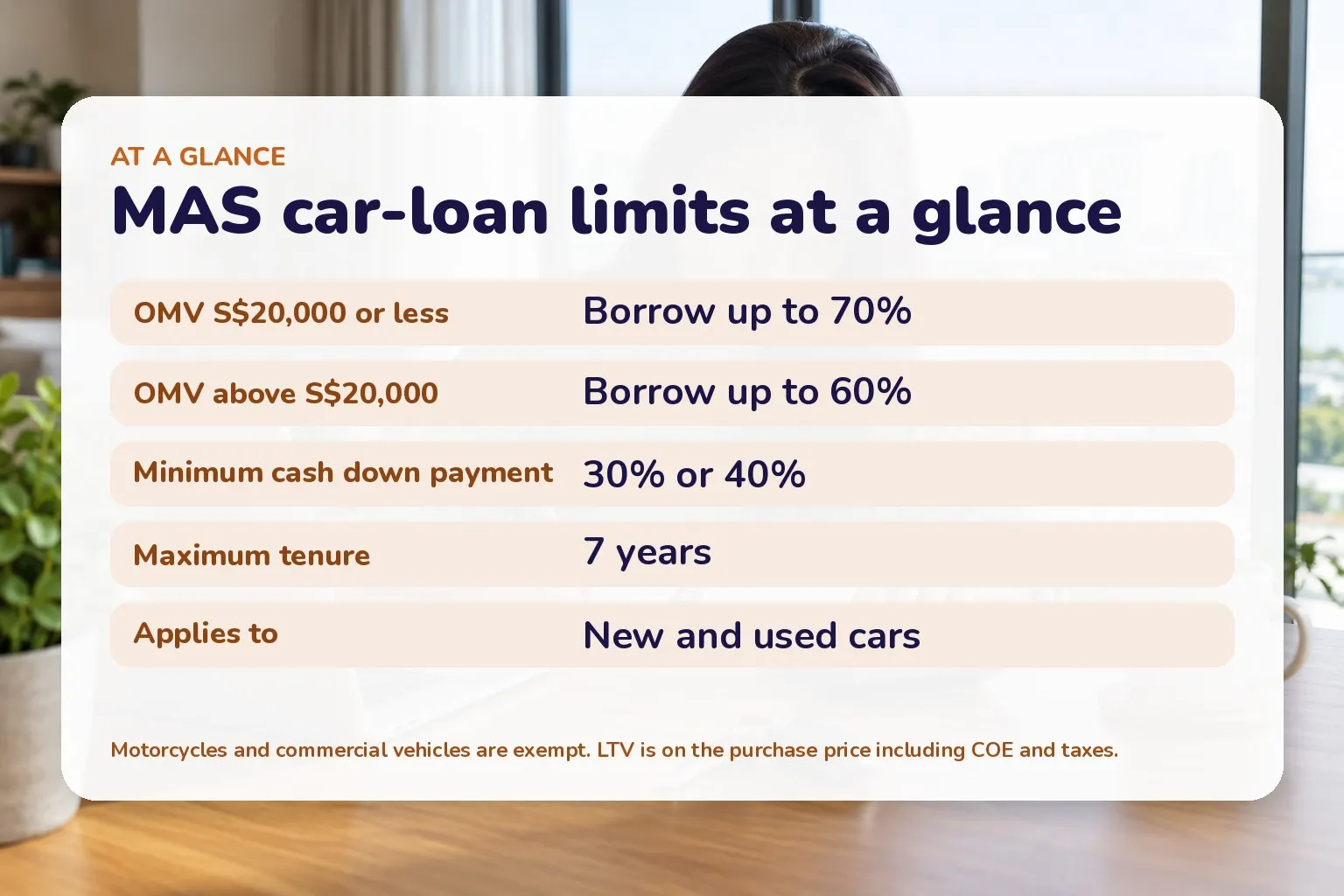
The MAS loan-to-value and tenure caps for car financing. — Source: MAS, Rules for Motor Vehicle Loans, October 2026.
The 7-year tenure cap
The maximum loan tenure is 7 years (84 months) for both OMV brackets. There is no way around it, and for a used car the practical limit can be shorter because a loan cannot sensibly outlast the car’s remaining COE. A longer tenure lowers the monthly payment but, as the worked example below shows, costs considerably more in total interest.
Who the rules do and don’t cover
The caps apply to anyone financing a new or used motor vehicle where the date of the purchase agreement is on or after 27 May 2016. They do not apply to:
- motorcycles and commercial vehicles; and
- vehicles for persons with disabilities or their caregivers.
For a used car, the value used to apply the LTV limit is reduced for age using a set formula:
OMV − [ (age of vehicle in months ÷ 120) × OMV ]
So a car that is halfway through a notional 120-month (10-year) life has its OMV roughly halved for loan purposes. That shrinks the base the LTV percentage is applied to, which is why financing an older car often means an even larger share of cash up front.
Flat rate vs effective rate: the real cost
Car loans are quoted as a flat rate — the interest is charged on the original loan amount for the whole tenure, not on the reducing balance. That makes the headline number look low. The arithmetic is simple:
- Total interest = loan × flat rate × tenure in years
- Monthly instalment = (loan + total interest) ÷ number of months
Because you keep paying the same interest even as the balance falls, the effective interest rate (EIR) — the rate that reflects the declining balance — is materially higher than the flat rate, often close to double for a typical multi-year car loan. This is exactly why the law requires disclosure.
Worked example: 5 years vs 7 years
Illustrative only — the flat rate below is an assumption, not a quoted rate; compare your lender’s disclosed figures.
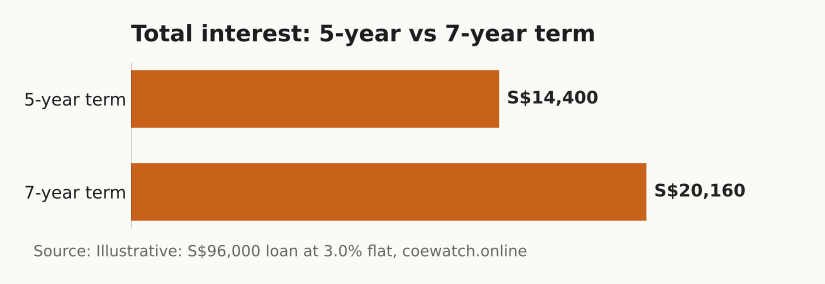
Illustrative total interest on a S$96,000 loan at a 3.0% flat rate; the 7-year term costs S$5,760 more.
Take a Category A car with a purchase price of S$160,000 (OMV above S$20,000, so 60% LTV). The maximum loan is 60% × S$160,000 = S$96,000, leaving a S$64,000 cash down payment. Assume a 3.0% flat rate:
| Tenure | Total interest | Total repaid | Monthly instalment |
|---|---|---|---|
| 5 years (60 months) | S$14,400 | S$110,400 | S$1,840 |
| 7 years (84 months) | S$20,160 | S$116,160 | S$1,383 |
Stretching from five years to seven drops the monthly payment by about S$457, but adds S$5,760 in total interest. The longer tenure is a cash-flow choice, not a saving.
Settling early: the Rule-of-78 myth
You have a statutory right to complete the agreement early. But how much interest you save depends on the method in your contract — and here a widespread myth needs correcting.
The “Rule of 78” (a sum-of-digits method that front-loads interest into the early months) is defined in the Hire-Purchase Act as the formula for a “statutory rebate.” Many guides claim every Singapore car loan uses it. That is out of date: the Rule of 78 has been no longer mandatory since the Hire-Purchase (Amendment) Act 2004. Lenders may use it, or an actuarial/simple-interest method, as long as they disclose the method upfront in your written statement of obligations.
So the practical rule is: do not assume an early payoff is cheap. Read the clause, and if the method is Rule-of-78-style, factor that into any plan to sell or replace the car within the first few years.
Refinancing a car loan
You can refinance a car loan up to the full outstanding amount. The maximum new tenure is (7 − X) years, where X is the number of years since the loan was first disbursed (or the remaining COE validity), subject to the lender’s credit assessment. In other words, refinancing does not reset the 7-year clock — a loan first taken four years ago can be refinanced for at most three more years.
Before you sign
- Budget the cash first. The 30–40% down payment is cash; confirm the OMV on your dealer’s quote to know which bracket — and which down payment — applies.
- Compare on EIR, not flat rate. Ask for the effective rate in writing; it is the only figure that compares fairly with other loans.
- Read the early-settlement clause. Confirm whether it is Rule-of-78-style and whether any fee applies.
- Match the tenure to your plan. If you may sell or deregister within a few years, a shorter tenure limits negative equity. See the true cost of owning a car.
FAQ
Can I use CPF to pay for a car? No. CPF savings are for housing, education, healthcare, investment and retirement — not vehicles — so the whole down payment must be cash. (Confirm current CPF usage rules on the CPF Board website.)
Does the loan cap use OMV or the price I pay? The LTV percentage is applied to the purchase price (including COE and taxes), but which bracket — 60% or 70% — is set by the car’s OMV.
Can I get a 10-year car loan like in some countries? No. The maximum tenure is 7 years, and for a used car it is effectively limited by the remaining COE.
Do these rules cover motorbike or van loans? No. Motorcycles and commercial vehicles are exempt from the MAS LTV and tenure limits.
Related
- The true cost of owning a car
- OMV, ARF and PARF rebate explained
- Scrapping vs exporting your car
- Car insurance in Singapore: what to know
General information on car financing, not financial advice. The MAS limits and Hire-Purchase Act provisions are current as of October 2026; the worked example uses an illustrative flat rate. Confirm current rates and your early-settlement terms with the lender before signing.
Sources
- Rules for Motor Vehicle Loans (LTV and tenure limits) — Monetary Authority of Singapore (as of October 2026)
- Calculating the Adjusted Value of Used Motor Vehicles — Monetary Authority of Singapore (as of October 2026)
- Refinancing Rules for Motor Vehicle Loans — Monetary Authority of Singapore (as of October 2026)
- Notice 642 — Motor Vehicle Loans — Monetary Authority of Singapore (as of October 2026)
- Hire-Purchase Act 1969 (statutory rebate, early completion, Second Schedule) — Singapore Statutes Online (AGC) (as of October 2026)