Scrapping vs Exporting Your Car in Singapore
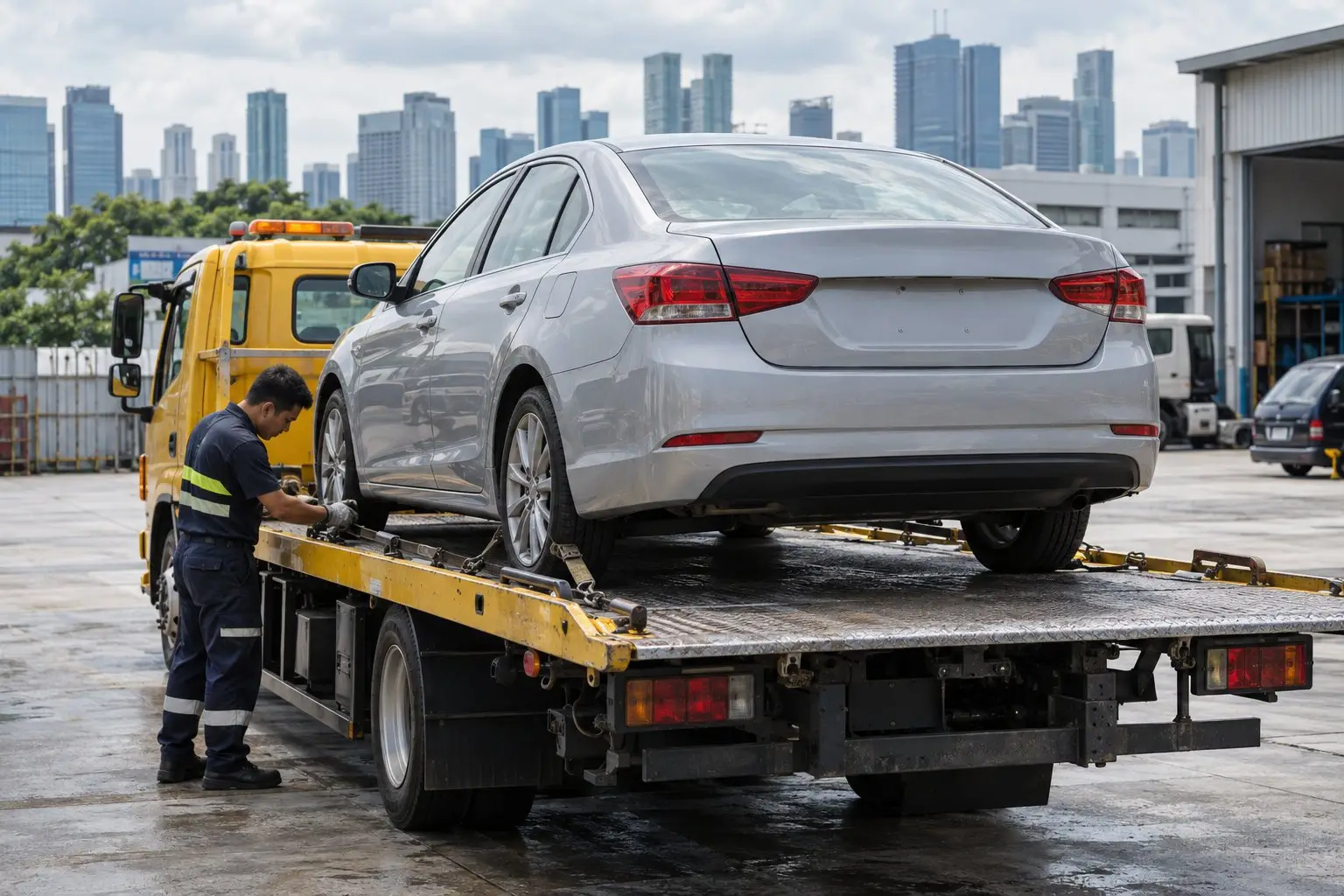
Scrapping and exporting pay the identical LTA rebate — PARF plus the unused COE. Exporting usually pays more overall because it also captures the car's resale value abroad, while a scrapyard adds only a small body value. Export wins when there is genuine overseas demand; otherwise scrap.
On this page11 sections · tap to jump
- 01Quick verdict
- 02Deregister first: the one step both paths share
- 03The rebate is the same either way
- 04What really differs: the body value of the car
- 05Path 1: scrap at an LTA-appointed scrapyard
- 06Path 2: export (with or without an EPZ)
- 07Deadlines, offences and loans
- 08Using your rebate: encash, offset or transfer
- 09How the 2026 PARF cut changes the maths
- 10Who should pick which
- 11FAQ
At the end of a car’s life in Singapore — whether the 10-year COE has run out or you simply want out early — you have to deregister the car and then dispose of it. The two choices that put money back in your pocket are scrapping and exporting. They are often talked about as if one is obviously more generous. In reality the big cheque — the LTA rebate — is the same either way; what differs is a second, smaller amount, and that is where the decision is actually won or lost.
Quick verdict
- Overall, for a car with real overseas demand: export. You collect the identical PARF and COE rebate and a dealer pays you the car’s export value, which is usually more than a scrapyard’s body value.
- For an old, high-mileage or low-demand car: scrap. When no exporter wants the car, scrapping is faster, simpler and the rebate is the same — you just forgo a body value that would have been tiny anyway.
- If you want the cash fastest and with least paperwork: scrap. Export involves shipping, an Export Processing Zone or export documents, and a buyer.
- If you are chasing the maximum total payout and have time: export — but get the export offer in writing and net off the logistics costs before deciding.
Deregister first: the one step both paths share
Deregistration cancels your vehicle’s registration. Once deregistered, the car can no longer be kept or used in Singapore, and you must dispose of it by one of three routes: scrap it at an LTA-appointed scrapyard, store it at an LTA-appointed Export Processing Zone (EPZ) pending export, or export it. Both the paths in this guide begin with this same deregistration step; the rebate is triggered by deregistration and proper disposal, not by deregistration alone.
Before you can deregister, two things must be clear: any outstanding payments or matters with LTA, and any outstanding loan on the vehicle with your finance company. A car still under financing cannot be deregistered.
The rebate is the same either way
When you deregister a car that still qualifies, LTA may grant you two separate rebates:
- PARF rebate — a refund of part of the Additional Registration Fee (ARF) you paid, available only if the car is not more than 10 years old at deregistration, was new (or an imported used car under 3 years old registered on or after 1 September 2007), and was never laid up.
- COE rebate — the unused portion of the Quota Premium (or PQP for a renewed COE), pro-rated to the time left on the 10-year COE, granted if you deregister before the COE expires.
Neither of these depends on how you dispose of the car. Scrap it or export it — the PARF and COE figures LTA pays are identical. That is the single most important thing to understand, because it means the common question “does scrapping or exporting pay more?” is really about a different, smaller number.
What really differs: the body value of the car
The money that actually separates the two options is the value of the physical car itself:
- Scrap: an LTA-appointed scrapyard takes the car apart. You receive the LTA rebate plus a small body/scrap value — in practice modest for an ordinary car, and often negligible for a very old one.
- Export: an exporter or dealer buys the car to sell overseas. You still receive the LTA rebate, and on top of it the car’s export value, which for a sought-after model in good condition can be meaningfully higher than scrap value.
Those body and export amounts are market prices set by dealers and scrapyards, not published by LTA, so treat any figure you are quoted as a negotiation point and get it in writing.
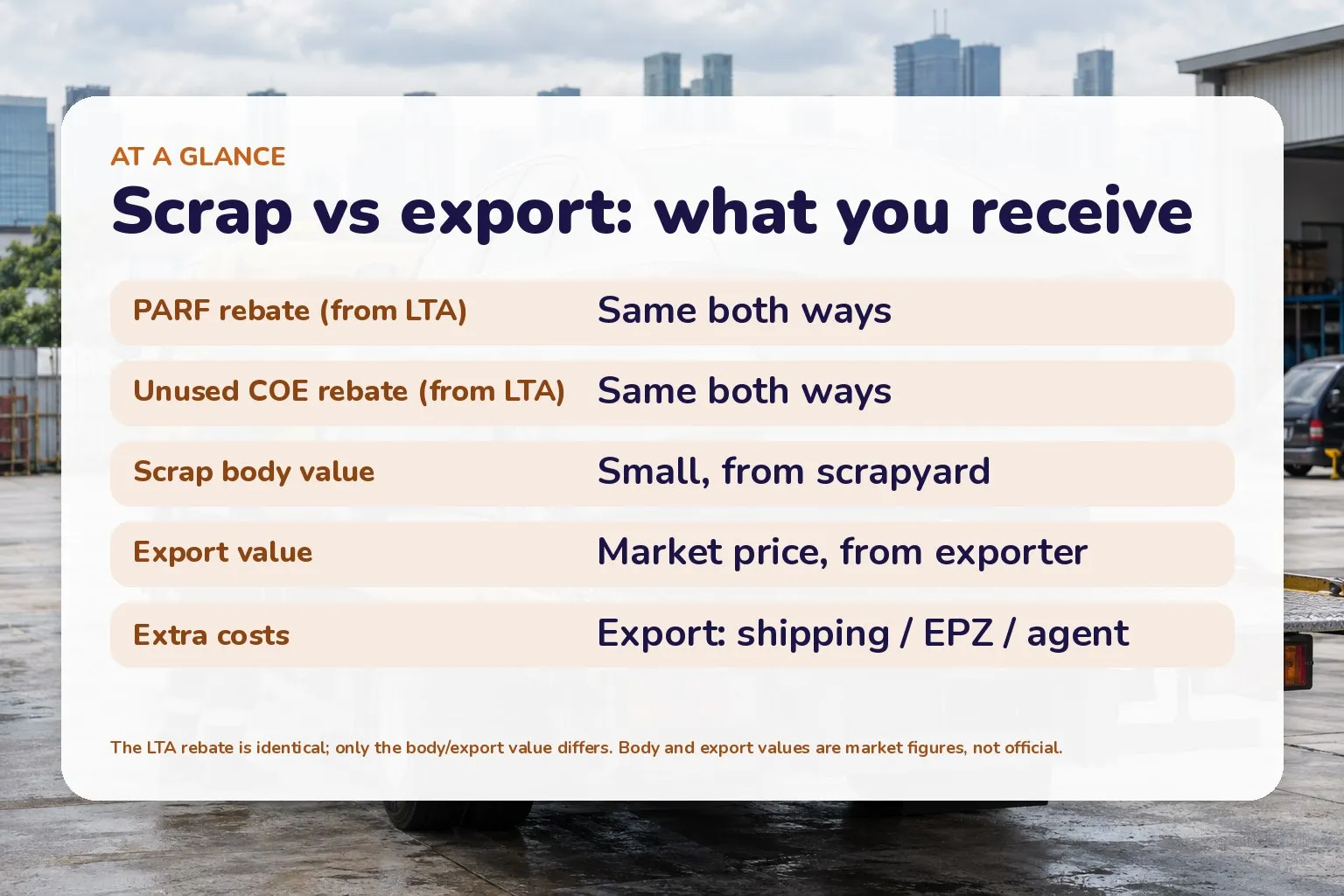
What each route pays. The LTA rebate is identical; only the body/export value differs. Body and export values are market figures, not official. — Source: LTA OneMotoring, October 2026.
Path 1: scrap at an LTA-appointed scrapyard
Scrapping is the simplest route. For a PARF-eligible car you drive or tow the car to an LTA-appointed scrapyard, then deregister it on the spot using the digital service with your Singpass 2FA. The scrapyard dismantles the vehicle and you receive the rebate and any body value.
Choose scrap when the car is old, high-mileage, or a model with little overseas demand — the cases where an exporter would offer little more than the scrapyard anyway. It is also the fastest way to get your rebate processed.
Path 2: export (with or without an EPZ)
Exporting lets you realise the car’s value in an overseas market. You either hand the car to a dealer who exports it, or you store it in an LTA-appointed EPZ pending export, or export it yourself. LTA requires export documents to confirm the car has genuinely left Singapore — these include the exporter/importer details, vessel/voyage number, port of discharge, container/seal number, the engine and chassis numbers, and the date the vehicle is shipped.
Choose export when the car has genuine resale demand abroad (common for certain popular or recent models) and you can wait for the shipping and paperwork. Net off the shipping, EPZ handling and any agent fees before comparing against a straight scrap.
Deadlines, offences and loans
Deregistration comes with hard rules, and they apply to both routes:
- One-month deadline. You must deregister, dispose of the car and submit the disposal documents to LTA within one month of the deregistration date.
- Don’t keep or drive it. It is an offence to keep or use a deregistered vehicle: a fine of up to S$20,000, or up to 2 years’ jail, or both (repeat offenders up to S$40,000 or 4 years). You must tow or transport a deregistered car to move it.
- No road tax, no insurance. A deregistered car has no valid road tax (driving it is a fine up to S$2,000) and is uninsured — using it risks a fine up to S$1,000 or 3 months’ jail and a mandatory 12-month driving ban.
- Clear the loan. The car must not be under financing when you deregister; road-tax arrears are collected during the transaction.
Using your rebate: encash, offset or transfer
Once granted, PARF and COE rebates are valid for 12 months from the deregistration date. They are separate entities, and within that window you can:
- Encash them (paid to your bank or by PayNow);
- Offset the Registration Fee, ARF, Quota Premium, used-car surcharge and CEVS surcharge on a new car; or
- Transfer them to another party — S$20 (incl. GST) per rebate per transfer. Divide a rebate first if you want to split it.
This matters for timing: if you are replacing the car, deregistering the old one lets you offset the new car’s taxes directly rather than finding that cash separately.
How the 2026 PARF cut changes the maths
From the second February 2026 COE bidding exercise onwards, the PARF rebate was cut sharply: the top band fell from 75% to 30% of ARF and the cap was halved from S$60,000 to S$30,000. LTA’s rationale is that as EVs become common and are less pollutive, there is less need to encourage early deregistration.
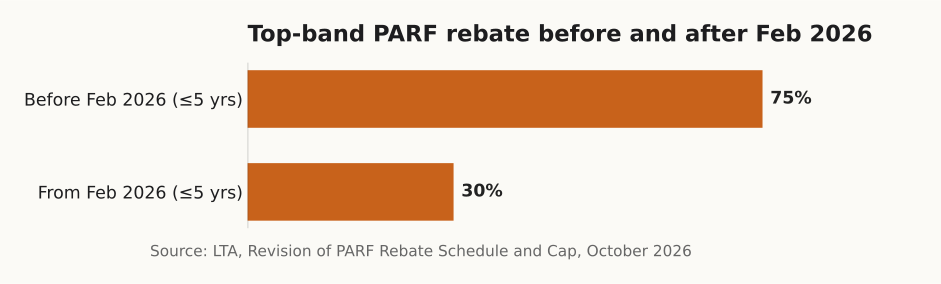
Top-band PARF rebate (car not more than 5 years old at deregistration), before and after the February 2026 revision. — Source: LTA, Revision of PARF Rebate Schedule and Cap, October 2026.
Three regimes now run in parallel, depending on when the car’s COE was obtained:
| Car’s COE / registration | Top-band PARF (≤5 yrs) | Cap |
|---|---|---|
| Before 15 Feb 2023 | 75% of ARF | No cap |
| 15 Feb 2023 – 12 Feb 2026 | 75% of ARF | S$60,000 |
| From 2nd Feb 2026 exercise | 30% of ARF | S$30,000 |
Because the rebate is now smaller for the newest cars, the export value becomes a bigger share of the total payout for those cars — so checking whether your model has export demand is more worthwhile than it used to be. For older cars still on a generous pre-2026 rebate, the rebate dominates and the scrap-vs-export gap is often small.
Who should pick which
- Export if your car is relatively recent, in good condition and a model wanted overseas, and you can wait for shipping/paperwork — you capture the same rebate plus a real resale value.
- Scrap if the car is old, high-mileage or unwanted abroad, or you simply want the rebate quickly with minimal fuss — you lose only a body value that would have been small.
- Renew instead of either only if you have run the numbers on the Prevailing Quota Premium against a replacement — remembering renewal forfeits the rebate entirely.
FAQ
Do I get a bigger rebate if I export instead of scrap? No. The PARF and COE rebate from LTA is identical. Export can pay more in total only because a dealer also pays for the car’s overseas value on top of the same rebate.
Can I claim the rebate if my car is already more than 10 years old? No. The PARF portion is nil once the car is more than 10 years old. You may still get an unused-COE rebate only if you deregister before the COE expires — which by definition means the car is 10 years old or less for a non-renewed COE.
What if I sell the car to another Singapore owner instead? Then you get neither rebate directly — the car keeps running on its COE and the locked-in rebate value is reflected in the resale price. See the true cost of owning a car.
Can a dealer handle everything? Yes. You can engage a motor dealer — ideally CaseTrust-SVTA accredited — but it remains your responsibility to ensure the car is properly disposed of and the documents reach LTA.
Related
- OMV, ARF and PARF rebate explained
- The true cost of owning a car
- Car loans in Singapore explained
- Car insurance in Singapore: what to know
General information on vehicle deregistration, not financial advice. Rebate rules, schedules and caps are from LTA as of October 2026; scrap and export values are market figures that vary — get written quotes and confirm current rules on LTA OneMotoring before deciding.
Sources
- Deregister a Vehicle (scrap, EPZ, export; offences, deadlines) — Land Transport Authority (OneMotoring) (as of October 2026)
- PARF & COE Rebate (eligibility, validity, using and transferring) — Land Transport Authority (OneMotoring) (as of October 2026)
- Vehicle Tax Structure (PARF rebate schedules and caps) — Land Transport Authority (OneMotoring) (as of October 2026)
- Revision of PARF Rebate Schedule and Cap (Budget 2026) — Land Transport Authority (as of October 2026)