EV Charging Cost in Singapore: Home vs Public
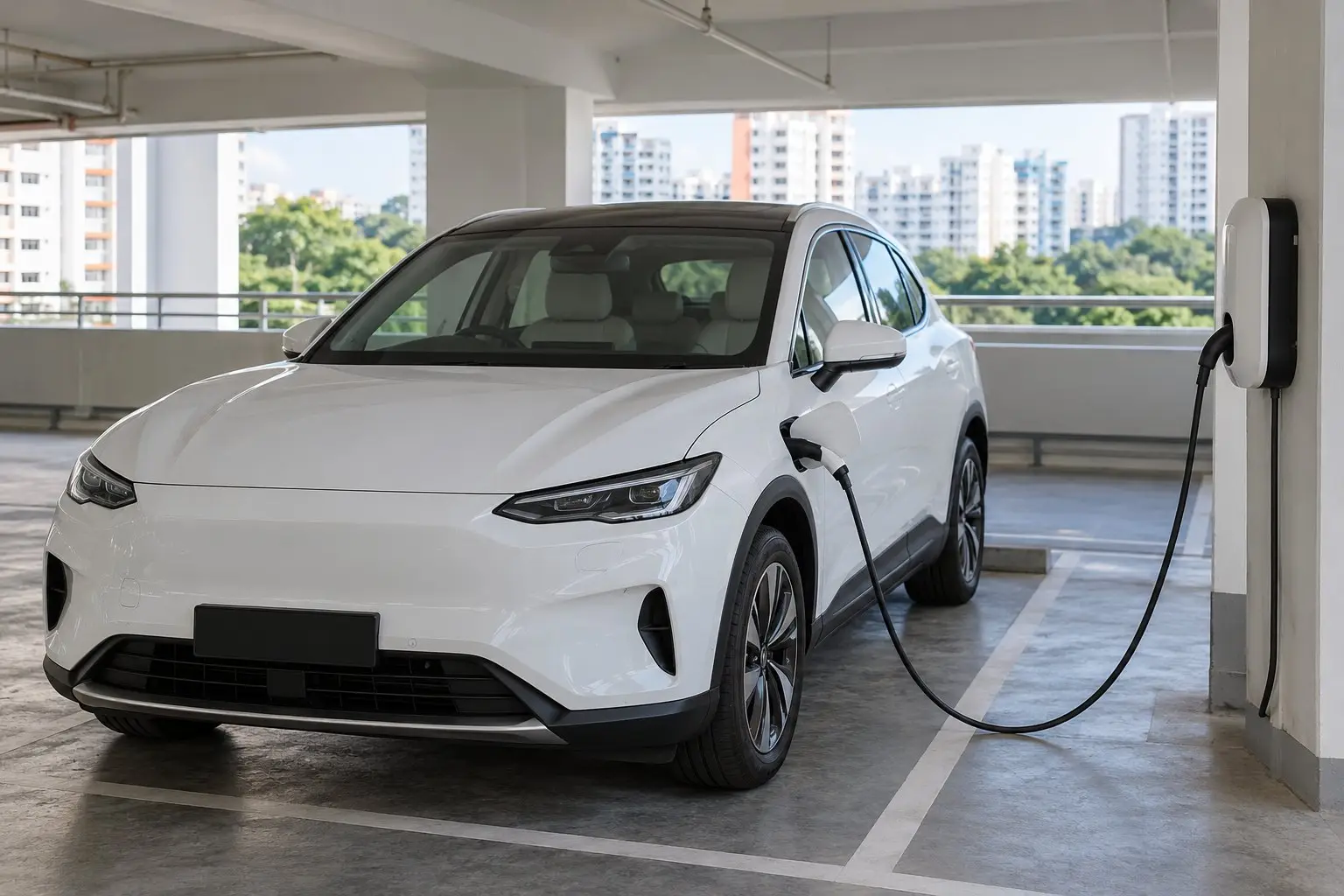
Charging at home on the regulated electricity tariff — 28.59 cents per kWh (31.16 with GST) for October to December 2026 — costs roughly S$5 to S$5.75 per 100km. Public chargers are priced by each operator and cost more, especially fast DC charging.
“How much does it cost to charge an EV in Singapore?” has no single answer, because it depends on where you plug in. Charging at home off your own electricity meter is the cheapest; public and fast chargers cost more and are priced by the operator. This guide works through each option with the official figures, so you can estimate your own cost. For how charging stacks up against petrol and the full running-cost picture, see petrol vs electric car: the real cost.
Charging at home: the cheapest option
If you charge on your own residential electricity account, you pay the regulated electricity tariff that SP Group sets each quarter under Energy Market Authority (EMA) guidelines. For 1 October to 31 December 2026 it is 28.59 cents per kWh before GST, or 31.16 cents with 9% GST. That tariff is made up of 22.18 cents of energy cost, 6.10 cents of network cost, a 0.23-cent market support services fee and a 0.08-cent market administration and power system operation fee (all before GST).
This household rate applies to a home billed on its own meter — in practice mostly landed homes with a dedicated charger. In an HDB or condominium carpark you usually plug into a charger run by an operator, which bills its own per-kWh rate (see below), not your household tariff.
Cost per 100km, worked out
Your real cost per 100km is the electricity your car actually draws from the wall, times the tariff. A commonly quoted efficiency of about 16 kWh per 100km is the car’s rated consumption; AC charging and battery conversion lose roughly 10–15% on top, so the meter reads a little higher than the rating.
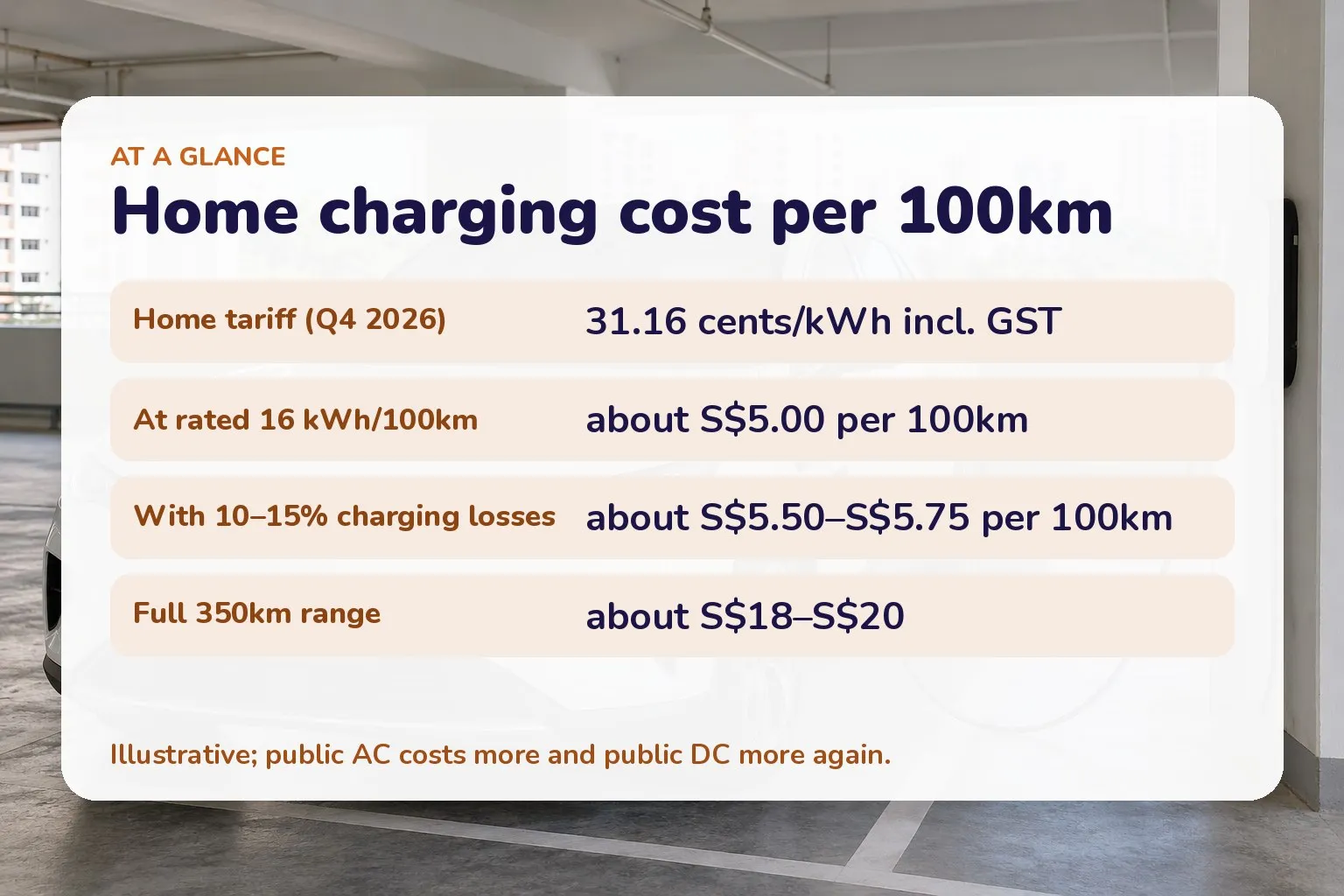
Home charging cost per 100km, illustrative. Source: SP Group tariff, Oct–Dec 2026.
Because the tariff and your car’s real-world efficiency both vary, treat these as a method rather than a fixed price: take your own tariff figure and your car’s observed kWh/100km and multiply.
Public charging: AC vs DC
Public chargers fall into two types, and the type matters more for cost than the brand on the unit:
- AC (alternating current) chargers — typically 7.4 kW to 22 kW — are the “slow” chargers found in most HDB and condo carparks. They are the cheaper per-kWh option and are designed for parking-while-charging.
- DC (direct current) fast chargers — 50 kW and up — top a battery up in tens of minutes rather than hours. They cost noticeably more per kWh and are aimed at quick top-ups and high-mileage users.
Each operator sets and publishes its own per-kWh rate, and the rate can differ by site and by time of day. There is no regulated public-charging price. As a rule, public AC is dearer than the home tariff, and public DC is dearer still — so the home math above is a floor, not a typical public cost.
How often you actually need to charge
A big reason home charging works for most people is that EVs here are not refuelled daily. LTA notes the average daily car mileage is under 50km and that EVs “commonly” have a range of around 350km, so “an average EV driver will only need to charge their vehicle roughly once a week.” That is why LTA treats low-powered overnight (slow) charging as optimal for most drivers — it is gentler on the battery and avoids expensive grid upgrades — with fast chargers reserved for high-mileage needs like taxis and fleets.
Where you can charge
Singapore is in the middle of a national roll-out. The Government targets 60,000 EV charging points by 2030 — 40,000 in public car parks and 20,000 in private premises — and reported 30,500 points deployed as at March 2026, described as on track. On the residential side, all HDB towns were “EV-ready” by December 2025, with more than 90% of HDB carparks already fitted with charging points, and the plan is for every HDB town to have at least one fast-charging hub by the end of 2027.
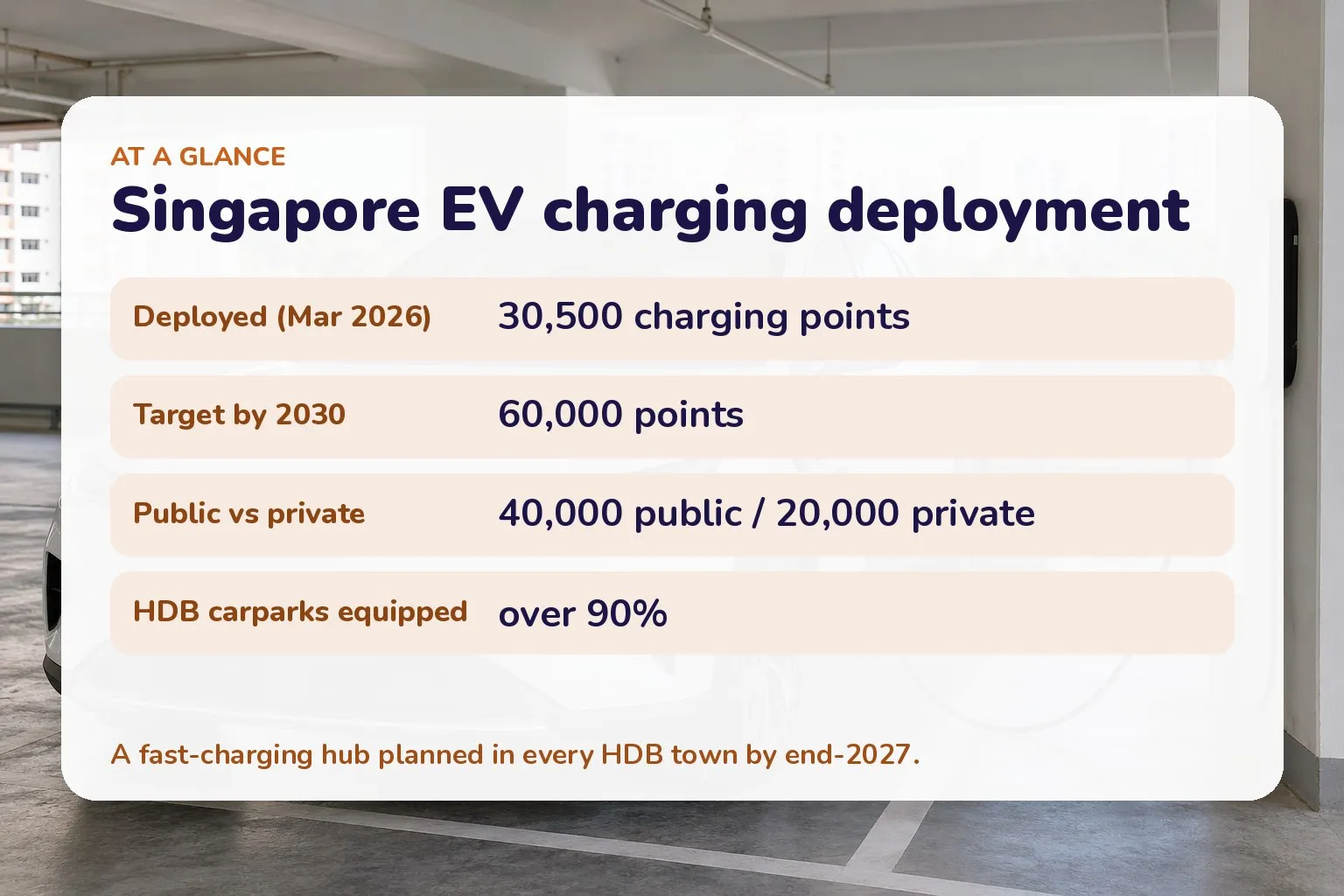
Singapore’s EV charging roll-out, official targets and progress. Source: MOT and LTA, 2026.
The networks themselves are large and operator-run: SP Mobility, for instance, states it operates 4,600+ charging points across 1,100+ locations, and Charge+ announced it had crossed 4,000 charging points in March 2026. Others — including CDG Energy (formerly CDG ENGIE), Shell Recharge and Tesla — run their own networks and rate cards.
Condos and the common-charger grant
Non-landed private homes are the tricky case: installing shared chargers in a condominium needs the management corporation to act. Two measures help. The EV Common Charger Grant, launched in July 2021, co-funds charger installation in non-landed private residences and runs until 31 December 2026, or until 3,500 chargers have been co-funded, whichever is earlier. And under the Electric Vehicles Charging Act (EVCA), in force since December 2023, the voting threshold for a condominium to resolve to install residents’ chargers was lowered to 50%. The EVCA also requires chargers to meet LTA safety standards and be registered, licenses charging operators (with uptime and insurance obligations), and mandates chargers in new and significantly renovated buildings.
Watch the idle fees
A cost that catches new EV owners is the idle fee — a per-minute charge some operators apply once your car has finished charging but is still plugged into the bay, to free up the charger for others. The grace period and rate vary by operator and are shown in the app. Factor it in for DC fast chargers especially, where leaving the car after it hits full can quietly add to the bill. (Exact idle rates differ by operator and are not published on a single official page, so check the app.)
Finding and paying
You can locate public chargers — with their location, pricing, power rating and plug type across operators — through the EV Charging Network module on the MyTransport.SG app. Payment is usually through each operator’s own app, though some offer guest checkout via a web link. Singapore’s national charging standard, SS 722, replaced the earlier TR25 on 1 April 2026, standardising the safety side of charging equipment.
Frequently asked questions
Is it cheaper to charge at home or in public? Home, almost always — you pay the regulated tariff (28.59 cents/kWh before GST for Q4 2026) rather than an operator’s marked-up rate. Public AC is dearer, and public DC fast charging dearer still.
How much does 100km cost? At the home tariff, roughly S$5–S$5.75 per 100km (illustrative, including charging losses). Public charging costs more depending on the operator and whether it is AC or DC.
Do I need to charge every day? Usually not. With average daily mileage under 50km and a typical 350km range, most drivers top up about once a week on a slow overnight charger.
Can I install a charger in my condo? Yes, if the management corporation agrees — the EVCA lowered that voting threshold to 50%, and the EV Common Charger Grant co-funds installation until end-2026 (or 3,500 chargers).
Why does my home charging cost change? The regulated tariff is revised every quarter to reflect energy costs; it fell 10.4% going into the final quarter of 2026, so your per-kWh cost moves with it.
Related
- Petrol vs electric car: the real cost
- EV rebates: VES and EEAI explained
- The true cost of owning a car
Home charging cost is based on the SP Group regulated tariff; public charging rates are set by each operator and shown in their apps. Figures marked illustrative (EV efficiency, cost per 100km) vary by model and driving. Not financial advice.
Sources
- Electricity Tariff Information (regulated household tariff, components) — SP Group (as of October 2026)
- Electric Vehicles — EV charger deployment, grants and EVCA — Ministry of Transport (as of October 2026)
- Our EV Roadmap (charger deployment, standards) — Land Transport Authority (as of October 2026)
- Develop convenient and comprehensive EV charging infrastructure (charging habits, 60,000 target) — Land Transport Authority (as of October 2026)
- Deployment of EV Charging Infrastructure in New Towns (points deployed as at March 2026) — Ministry of Transport (as of October 2026)