Car Depreciation in Singapore Explained
Depreciation is the money you cannot get back: the price you paid minus the COE and PARF rebates you would recover on deregistration, spread over the years you own the car. In Singapore it is by far the largest ownership cost — much bigger than fuel.
In most countries depreciation is the gap between what you paid for a car and what you can sell it for. In Singapore it is the single most important number in car ownership — bigger than fuel, insurance, road tax and parking combined — because the COE and the taxes that make a car so expensive here are largely money you never get back.
How depreciation is calculated
Depreciation per year is just the value you lose divided by the time you own the car:
Depreciation per year = (price you paid − expected rebates at the end) ÷ years of ownership
“Expected rebates” are what you recover when you deregister the car: the rebate for the unused COE plus any PARF rebate (a portion of the ARF you paid). Everything else — the GST, the excise duty, the registration fee and the used-up part of the COE — is gone for good. For how those upfront taxes are built, see OMV, ARF and PARF explained.
Why the COE makes depreciation so large
A car’s price in Singapore is dominated by the COE and the ARF, not the metal. The COE is fully used up over its 10 years and returns nothing at the end, so most of what you pay is destined to disappear. These are the current premiums, updated after each bidding exercise:
| Category | Quota premium | Quota | Bids received |
|---|---|---|---|
| Cat A · cars ≤1600cc & ≤97kW | $132,004 | 1,191 | 1,574 |
| Cat B · cars >1600cc or >97kW | $131,901 | 923 | 1,149 |
| Cat C · goods vehicles & buses | $92,200 | 308 | 481 |
| Cat D · motorcycles | $10,778 | 539 | 611 |
| Cat E · open | $135,790 | 270 | 411 |
Historical official results, updated after each exercise — not a forecast. See all COE data →
When premiums are high, new-car depreciation is high too, because there is simply more non-recoverable cost to write off. That is also why a car’s depreciation can look very different depending on the COE premium it was registered with. See what COE is and how it works.
The PARF rebate — and the 10-year cliff
The one meaningful slice of value you can recover is the PARF rebate: a percentage of the ARF you originally paid, based on the car’s age when you deregister it. It falls as the car ages and drops to nil once the car is more than 10 years old.
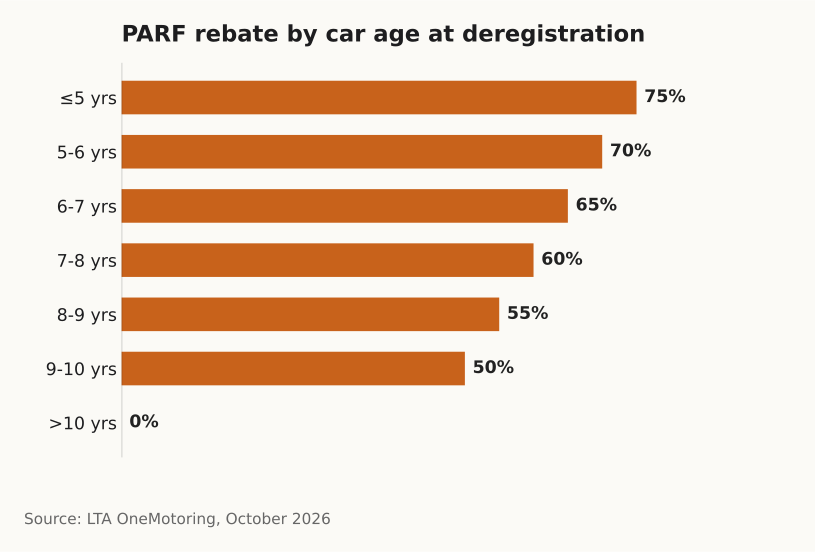
PARF rebate as a percentage of ARF paid, for cars with COEs from the Feb 2023 to Feb 2026 exercises (cap S$60,000); the rebate is nil beyond 10 years.
Because the rebate hits zero after 10 years, a car driven to the end of its COE depreciates by essentially its entire purchase price. Deregistering even a little earlier recovers both the unused-COE rebate and the PARF rebate — which is why depreciation per year is usually lower if you sell before the 10-year mark.
A worked example (illustrative)
Take an illustrative Category A car with an on-road price near S$192,000 (see the full build-up in the true cost of owning a car). Held for the full 10 years, the PARF rebate is nil and the COE is spent, so almost the whole price is lost — roughly S$19,200 a year in depreciation alone, before a single dollar of fuel, insurance or parking.
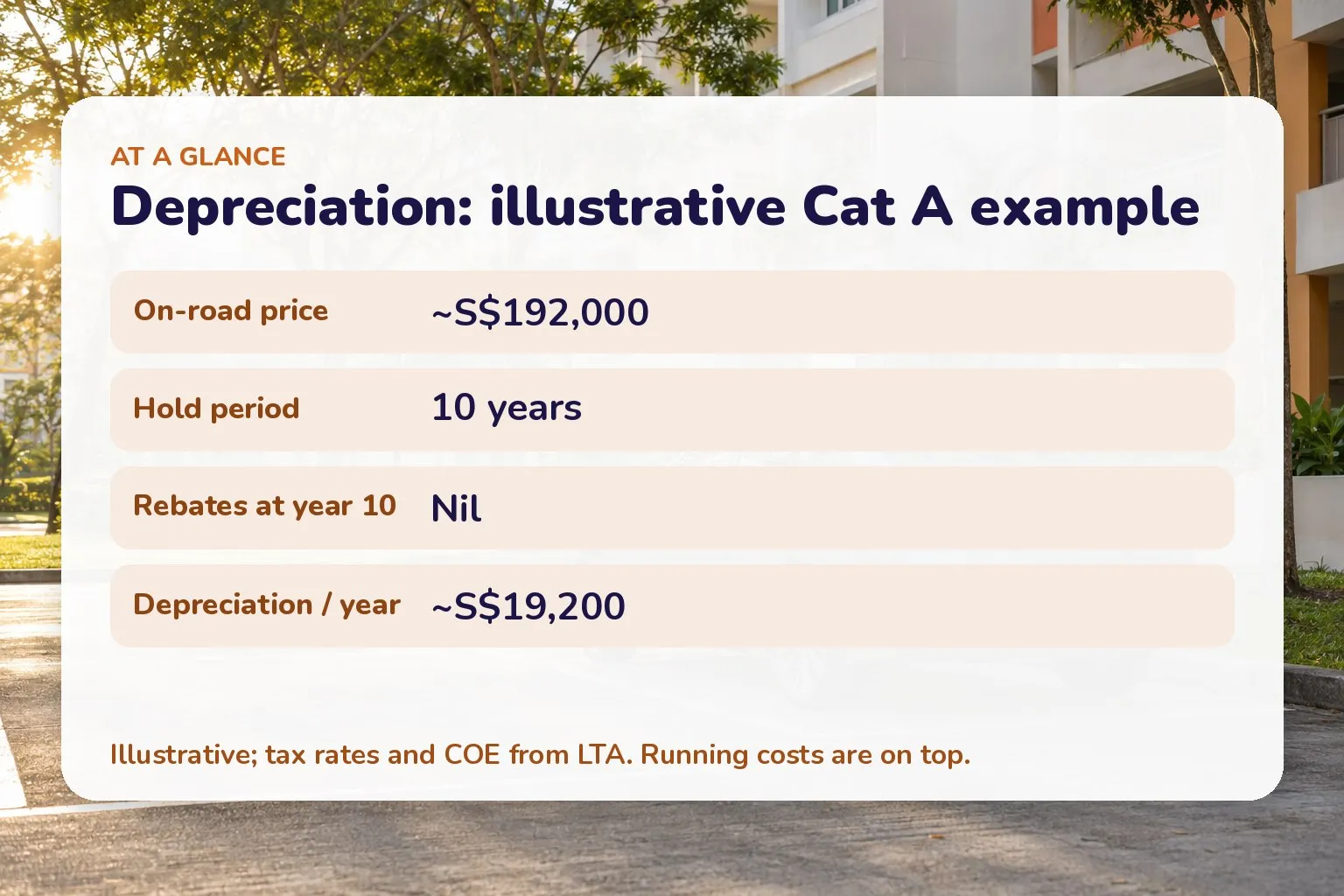
Over a full 10-year hold almost the entire price is lost to depreciation.
This is the number buyers most often underestimate, and it dwarfs running costs. By comparison, the road tax on a typical 1,600cc petrol car is a fixed figure of about S$743 a year, and fuel for an average commute is a few thousand dollars — real money, but small next to a five-figure annual depreciation. Depreciation is the line to attack first if you want to cut the true cost of a car.
How to use depreciation when comparing cars
- Work out depreciation per year for every car on your shortlist, new or used, using the formula above.
- For a used car, a lower sticker price with few COE years left can still mean higher annual depreciation than a dearer car with more time on the clock. Our new vs used car guide walks through this trade-off.
- Remember the rebates are a floor, not a promise of profit: the market price you actually get can sit above or below the car’s paper value.
- Check which PARF regime your car falls under — the pre-2023, Feb 2023–Feb 2026, or post-Feb-2026 rules all give different rebates.
Related
- New vs used car: which makes sense?
- The true cost of owning a car
- OMV, ARF and PARF rebate explained
- Buying a used car in Singapore
- COE renewal and PQP explained
General information, not financial advice. The worked example is illustrative; tax rates, rebate rules and COE premiums are from LTA and data.gov.sg as of the dates stated and change over time.
Sources
- Vehicle Tax Structure (ARF, PARF rebate, road tax) — Land Transport Authority (OneMotoring) (as of October 2026)
- Upfront Vehicle Costs (OMV, ARF, COE) — Land Transport Authority (OneMotoring) (as of October 2026)
- COE bidding results (premiums by category) — LTA via data.gov.sg (as of 21 October 2026)