New vs Used Car: Which Makes Sense?
There is no universal winner. A new car gives a fresh 10-year COE, a full warranty and the latest tech; a used car is usually cheaper per year early on because the first owner already absorbed the steepest loss. Compare both on depreciation per year, not the sticker.
New or used? In Singapore the honest answer is that neither always wins — it depends on how long you will keep the car and how much of the early depreciation you want someone else to pay. A new car gives you a fresh 10-year COE, a full warranty and the latest safety and efficiency. A used car is usually cheaper to run per year in its early years, because the first owner has already absorbed the steepest loss. The trick is to compare them the same way.
Depreciation per year is the real comparison
The fairest measure is how much value a car loses each year you own it:
Depreciation per year = (price you pay − expected rebates at the end) ÷ years you keep it
“Expected rebates” means what you would recover on deregistration: the rebate for the unused COE plus any PARF rebate (part of the ARF, only if the car is deregistered within 10 years). See car depreciation in Singapore explained for the full method, and OMV, ARF and PARF explained for how the rebates are built.
A new car loses the most in its first years, because the fresh COE and the full ARF are large and the car has its entire 10-year life ahead of it. A used car bought a few years in skips that steepest part of the curve — but it also has fewer COE years left, which can push its annual depreciation back up if you overpay.
What the fresh COE costs today
A new car pays the current COE premium in full. These are the latest official figures, updated after each bidding exercise:
| Category | Quota premium | Quota | Bids received |
|---|---|---|---|
| Cat A · cars ≤1600cc & ≤97kW | $132,004 | 1,191 | 1,574 |
| Cat B · cars >1600cc or >97kW | $131,901 | 923 | 1,149 |
| Cat C · goods vehicles & buses | $92,200 | 308 | 481 |
| Cat D · motorcycles | $10,778 | 539 | 611 |
| Cat E · open | $135,790 | 270 | 411 |
Historical official results, updated after each exercise — not a forecast. See all COE data →
Because the COE is usually the single biggest line in a new car’s price, a used car — whose COE was won in an earlier, often cheaper exercise — can look very attractive when premiums are high. See what COE is and how it works.
What a new car gives you
- A fresh 10-year COE, so you are not buying someone else’s remaining years.
- A manufacturer warranty and no hidden history — no previous accidents or wear.
- The latest safety, efficiency and emissions performance, which can also affect road tax and any emissions rebate or surcharge.
- A clean transaction with the dealer, usually including COE bidding on your behalf.
The cost of all this is the steep first-years depreciation: you are the one paying the full fresh COE and the full ARF.
What a used car gives you
- A lower purchase price, because the first owner absorbed the early depreciation.
- Often lower annual depreciation in the middle of a car’s life — if you do not overpay for the remaining COE.
- Faster availability — no waiting for a COE bid to clear.
But there are real catches, and they are the reason a used car is not automatically the cheaper choice.
A worked comparison (illustrative)
Think of the same model two ways. Bought new, it carries the full fresh COE and the full ARF, so the early-years depreciation is high — on an illustrative Category A car the on-road price can sit near S$192,000, and over a full 10-year hold essentially the whole price is lost (see the true cost of owning a car).
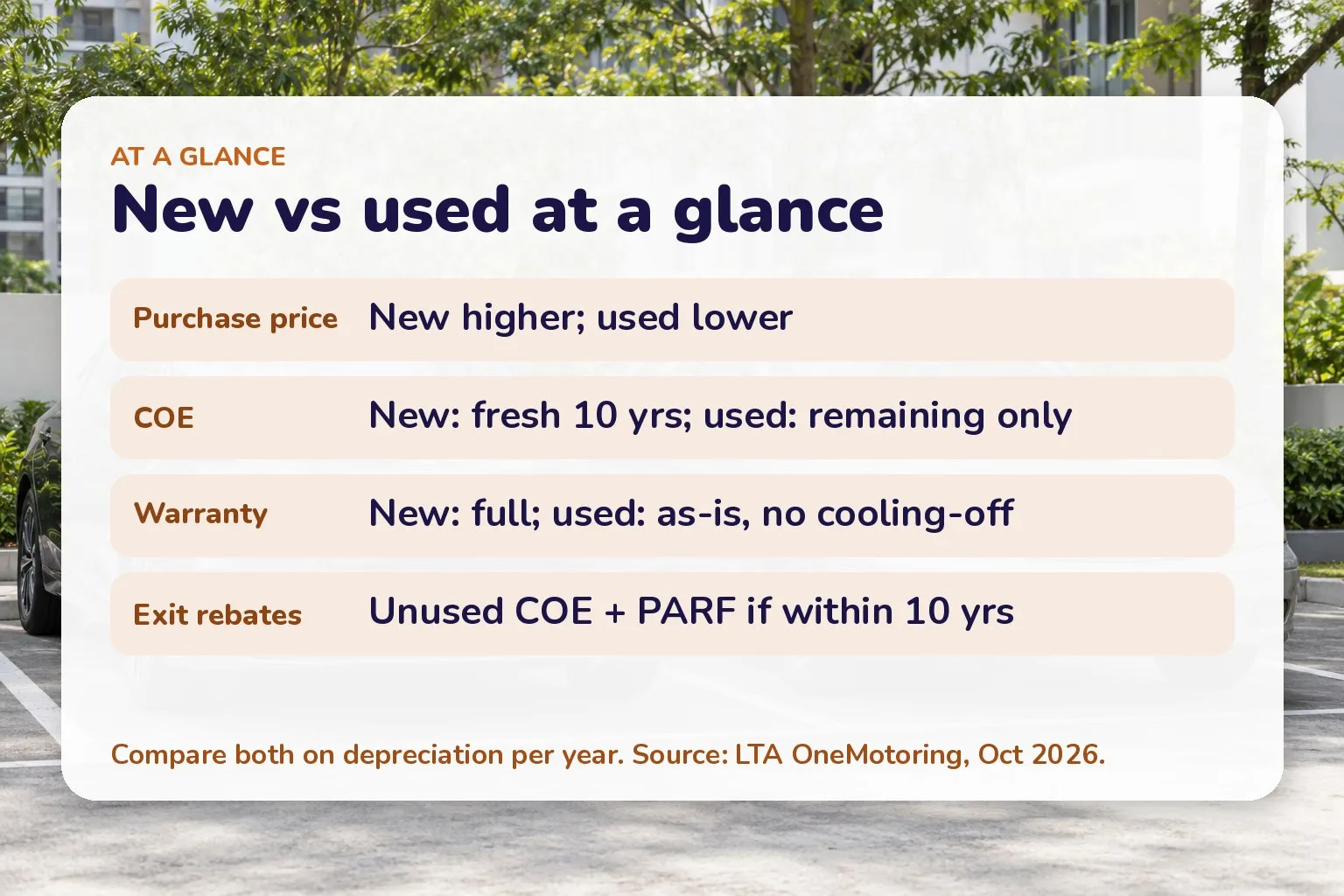
The trade-off: a new car’s fresh COE and warranty versus a used car’s lower upfront price.
Bought used at, say, four years old, you pay far less upfront and skip that steepest part of the curve. But you now own a car with fewer COE years left, so the yearly loss depends heavily on the price you pay versus the rebates you will recover at deregistration. Run both through the depreciation-per-year formula before deciding.
Financing and other costs
Both new and used car loans are subject to MAS financing limits — a loan-to-value cap based on the car’s OMV and a maximum loan tenure. For a used car, the OMV is depreciated by the car’s age before the cap is applied, which can change how much you may borrow. Rules and caps change, so check MAS directly before you budget.
Running costs — road tax, insurance, maintenance and parking — apply to both, though an older used car tends to need more maintenance as it ages. Insurance for a newer, more powerful or more valuable car can also cost more; see car insurance in Singapore.
So which should you choose?
- Choose new if you want a full 10-year COE, warranty peace of mind and the latest tech, and you plan to keep the car long enough to spread the early depreciation.
- Choose used if you want a lower price and lower annual depreciation, you are comfortable inspecting a car bought “as is”, and the remaining COE years suit how long you will keep it.
Either way, the decision comes down to one number: depreciation per year. Work it out for each car you are considering, and the cheaper one to own usually becomes obvious.
Related
- Car depreciation in Singapore explained
- Buying a used car in Singapore
- The true cost of owning a car
- OMV, ARF and PARF rebate explained
- What is COE and how it works
General information on buying a car, not financial advice. Figures and rules are from LTA and data.gov.sg as of the dates stated; confirm current requirements before you buy.
Sources
- COE bidding results (premiums, quota, bids by category) — LTA via data.gov.sg (as of 21 October 2026)
- Vehicle Tax Structure (ARF, PARF rebate, used-car surcharge) — Land Transport Authority (OneMotoring) (as of October 2026)
- Buying a vehicle (checks and transfer) — Land Transport Authority (OneMotoring) (as of October 2026)